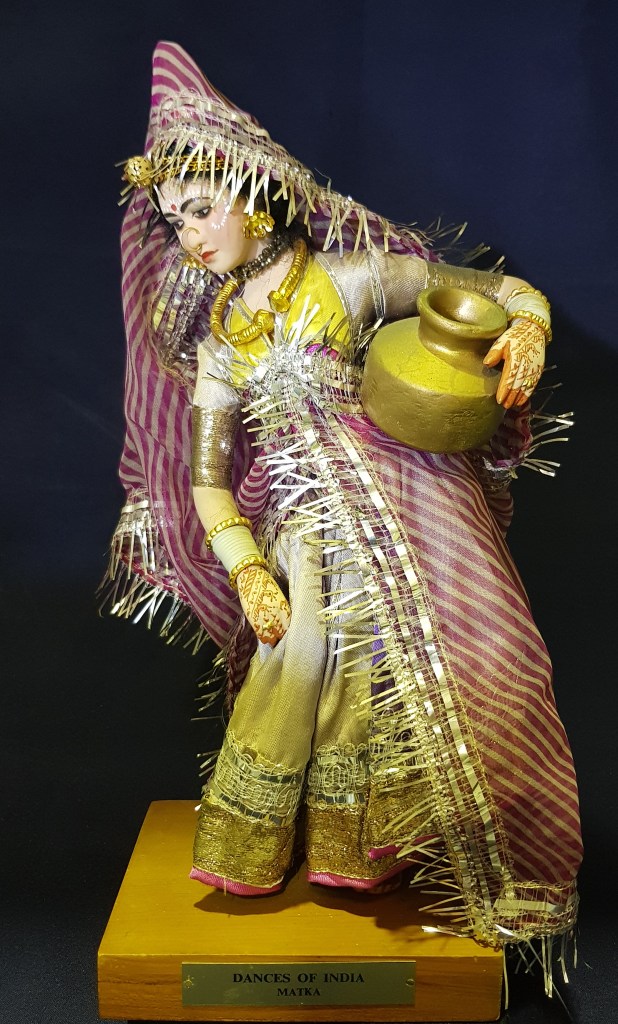
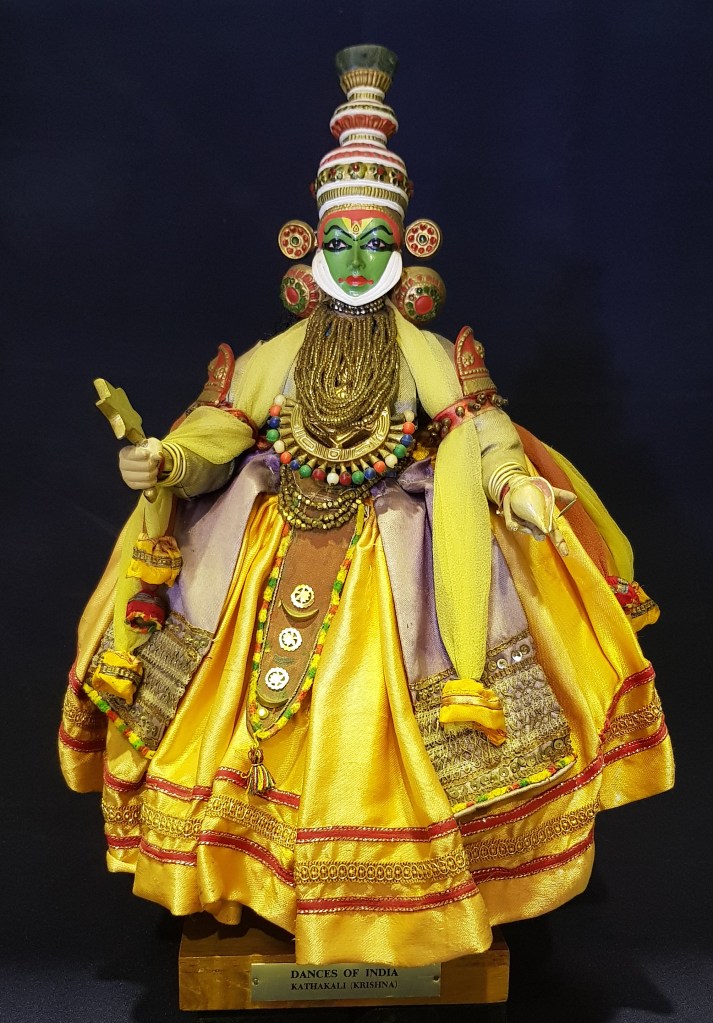
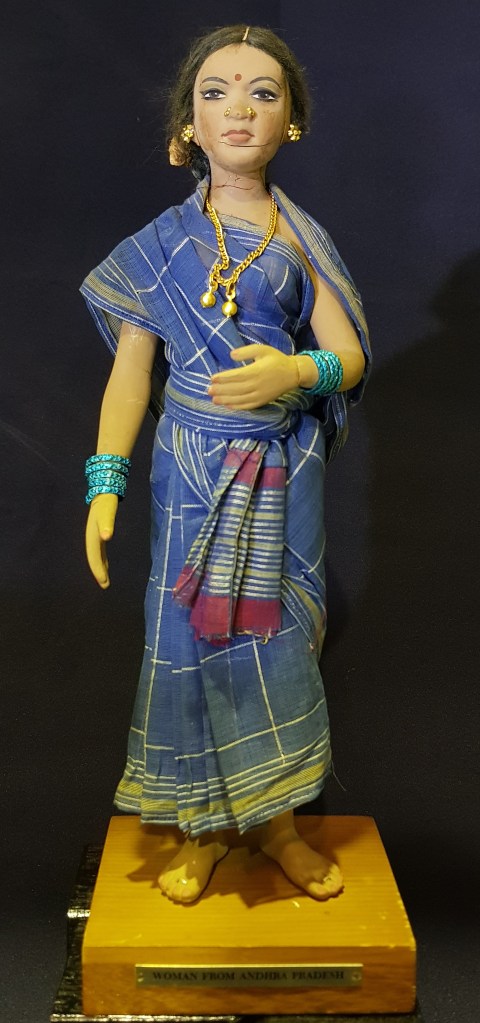
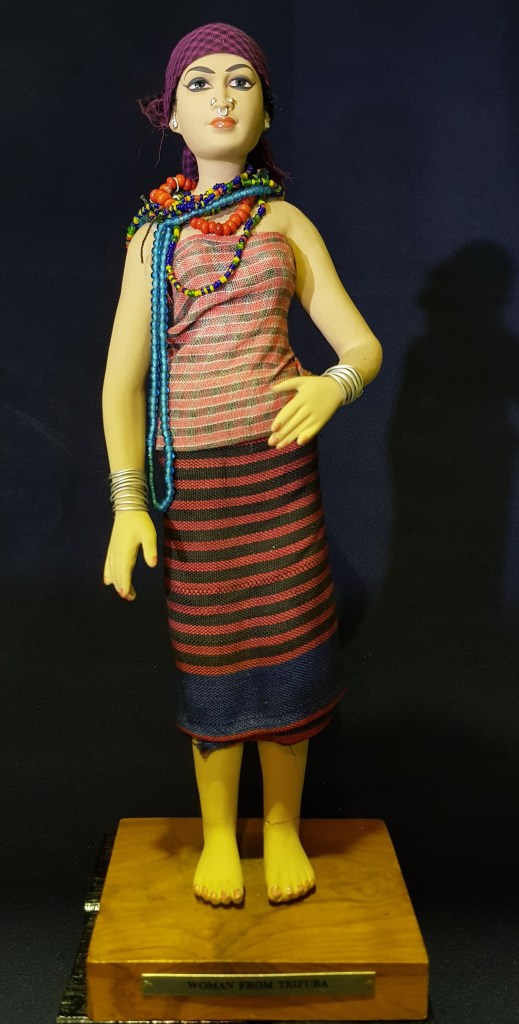
These remarkable Indian dolls comprise an unexpected group within the Logan Historical Museum collection.
In 1980, Everton Park residents Marjorie and Jim Fainges become the founder-proprietors of Panaroo’s Playings Dolls and Toy Museum, in the former public library at Windsor. Jim, a glazier and professional model-maker, was a model train enthusiast. Marjorie, an office administrator, had been collecting toys and dolls for some years. She co-founded the Brisbane Doll Society in 1976 (and still attends meetings).
Soon after opening Panaroo’s Marjorie and Jim worked together to outfit 120 Barbie and Ken dolls in Australian costumes dating from 1788 to the early 1980’s. Marjorie researched and stitched the dolls’ clothes, cut from patterns made by Jim. Originally displayed at Panaroo’s, these dolls are now in the Logan Historical Museum collection.
From 1986, Marjorie was to research and write 16 standard reference works on dolls and toys of Australia.
Word of the historically-outfitted Australian dolls at Panaroo’s reached Shankar’s International Doll Museum in Delhi, India. Opened in 1965, the Shankar collection grew steadily through gifts and exchanges from international visitors. In the late 1980’s, Marjorie received a letter from Shankar’s, asking for a doll representative Australian dress. As there is no ‘national costume’ amongst post-colonial Australians, Marjorie and Jim dressed 40 specially made clay dolls in various styles from Australia’s colonial period to the 1980’s and sent them to Delhi.
In return, Shankar’s Museum sent Marjorie 40 magnificent dolls representing individuals from various regions in India, made by artisans at Shankar’s own workshop. though held up for some time at the Indian High Commission in Canberra, upon redirection to Brisbane they were displayed at Panaroo’s and Marjorie recalls, at City Hall in the early 1990’s.
Marjorie donated all but a few of her beautiful Shankar’s Dolls to the institution that has evolved into the Logan Historical Museum, where they have remained in their cabinet for some 30 years.
These dolls were once displayed at Panaroo’s Playthings on Lutwyche Road, Windsor. Panaroo’s was Australia’s largest-ever museum of childhood. When Marjorie and Jim Fainges developed health problems in the late 1980s, there were some moves to roll the contents into a new public collection, but these came to nothing. The couple offered various Australian museums the choice of some 10 000 items. Queensland Museum acquired about 1000 Australian-made dolls and toys; Museums Victoria also had a significant slice of the Fainge’s collections. Most of the rest to auction.
The Republic of India is currently divided into 5 regions, 28 states and 8 unions territories. Each state and territory is pluricultiral and multilingual; also hundreds of languages are spoken in India. its Adivasi (Indigenous people) comprise well over 700 different ‘Scheduled Tribes’, who make up nearly 10% of the total population. Only the Banjara, Naga and Santhal tribes are represented here. Apart from the dancers, all the other dolls are labelled with a state or in the case of Jammu and Kashmir – territory.
India has eight (or nine, depending on the authority) classical dance forms. Kathak originated in the north, encompassing Utta Pradesh, Rajasthan and Madhya Pradesh, and the Union Territory of Delhi. Odissi began in began in Odisha (formerly Orissa) in northeast India; Kuchipudi, in Andhra Pradesh in southeast India. The Kathakali dance expresses stories of the Hindu epics Ramayana and the Mahabharata; Krishna is distinguished by the green face worn by heroes and deities, while Ravana had the red and black face traditionally indicating an evildoer.
The Museum wishes to thank Dr Sarah Engledow, Senior Research Officer of the Museum of Brisbane for her research,
The following is a memory of his school days at the Waterford State School in the 1940s by Ken Bizzell
The first indications that the war was coming closer to us at the Waterford State School was when we had to carry out “Air Raid Drills”. The tolling of the Lutheran church bell at Bethania meant that air raid precautions had to be taken. All the children some with pegs in their mouth and other with rubber plugs in their ears would run to the air raid trenches, dug in a zig-zag fashion along the back fence of the school teacher’s house. After the “All clear” it was back to classes—we thought, what fun this is! Thankfully no air raids ever took place.
During modelling class where plastine was used most of the boys would make aeroplanes such as Wirraways, Liberators, Flying Fortresses and Lockheed Lightnings—these were American fighter planes with a twin fuselage.
On the wall next to the blackboard were coloured drawings of many different bombs, mines and hand grenades with an inscription which read “If any of these dangerous weapons are found do not touch”, at this time we were well versed in safety by our wonderful teacher, Mr Tom Richmond.
The children would eagerly line up along the school fence, in Nerang Street watch the long convoys of American vehicles, troop carriers. Jeeps by the score and Yankee 10 wheeler trucks towing artillery guns and war equipment with camouflage nets draped over them as they passed. We all knew, the Yanks were going to war to help to protect Australia. We learnt all these troops and equipment were based at Camp Cable near Logan Village. The US 32nd Infantry Division “the Red Arrows” were stationed there with the 503 Paratroopers Infantry. The total US contingent totalled some 30,000 men.
As time went on, we took notice that US Military Police wore MP Arm Bands just below the shoulder, when they were trying to round up servicemen who had gone A.W..O.L. that was ‘absent without leave’ from their camp for a day or two. The senior boys at school would wear M.P. arm bands to show their authority to the rest of the school. ‘Yankee caps’ were the flavour of the day most boys wore them to school for years.
When in class, sometimes the roar of low flying aeroplanes were deafening also the practice dog-fights by the fighter planes were fantastic for the children to see. A sight to behold was when the paratroopers jumped out of Douglas D.C.3’s near Logan Village and we could see them from Waterford 7 miles (approx. 12 ½ kms) away. A mock ‘air raid’ by 4 dive bombers on our local high-sided, cement bridge over the Logan River one event I will never forget.
A thrill for the all the children was to see a ‘Ack Ack Gun’ under the Bunya pines across the road from the school. There were three other guns across the river at Tygum this made up the defense of this vital bridge which was only one car wide. I also remember that the Australian Bren Gun Carriers (which looked similar to a very light tank without out a turret). May I mention it was believed, that a small army camp of Australian soldiers, were stationed some where on Bark Hill. If you are not aware of the situation of Bark Hill, it is the high area when travelling from Waterford to Beenleigh, this road was so corrugated that it was a “night-mare” to all to travel on.
When word spread around Camp Cable—there were two hotels at Waterford, an influx of US personnel came to our township. My parents Viv and Mavis Bizzell owned the only shop in Waterford which was situated on Albert Street, where the BP service station stands today. It was a mixed grocery business. However, Dad stocked everything needed for a country town. The Post Office was operated within the shop.
Many a US soldier arrived at Waterford in the back of Mr Larry Storey’s chev ute. Later in life Larry became our Shire representative and a man who man who gave much of his life to helping the community in the Logan area and for these efforts he was credited with several awards.
When the US servicemen arrived at Waterford they wanted something to eat so my mother decided to serve steak and egg or chicken meals with dessert for 2/6 (25 cents). I remember this story that Mum told for years, about a very young US soldier who beckoned her over as he ate his meal to tell her that there were “flies in his dessert”. Mum explained that the black things in his fruit salad were passionfruit seeds, he was not convinced at all and never ordered dessert again. My parents told me that, all of the US servicemen they had known were of the highest discipline, well mannered and polite.
Of the many regular US soldiers that called in for a meal—I can still recall some of their names—Hank, Cauley, Evertt, Little Joe, Howard, Lip, Jim and Floyd. Something that I treasure very dearly is a letter written by Everett Alexander in New Guinea dated the 20th June 1944 for seventh birthday a copy of which is on display. Mum told me later by the time we received this letter, Evett had been killed in action. I always believed he was there defending, my brother, Grahan and myself now that I am the age of 76, I still feel the same way “bless his soul”.
My mother would write to service-men and their parents to give them support. Here is parts of a letter Mum received from a US service man (Dec 20th 1945). The last letter I wrote to you, I was at Oro Bay New Guinea having been injured I am now back in the USA still remember Waterford, hope to go to Australia again sometime. Your hospitality to us was great. Enclosed Christmas card will be late , by the spirit is with you any way. Say hello to Larry Street (Larry Storey) and the tall girl May Sailer) who knew Floyd. Our outfit the 503 Paratroop infantry jumped on Corregidor Island February 16th 1945. I broke my shoulder and severely injured my back, hospitalized for two months. You may know this but Floyd was killed on Corregidor Island and your friend Anthony was still on Negros Island in the Philippines when I last saw him he was badly knocked about. I hope to hear from you soon, your friend, Jim Berzhinski, 6242 Regular Street, Detroit, Michigan USA.
I have in my possession a Japanese Government ½ shilling note and one shilling note (printed in the English language). These notes were taken from a Jap by US soldier and given to Dad. Some believe these notes were to be the currency in Australia, if the Japanese were successful in their invasion.
A few other items come to mind to do with the way of life in our area during the dark days of World War Two. Petrol, clothing and some food items such as tea, butter and meat were rationed and they could only purchased by producing ration ticket which were issued to the public. Petrol was rationed from 1st October 1940 to 8th February 1950. At one stage during this period the public was asked not to travel further 15 miles (22 kms) from your home so as to conserve petrol. Commercial travellers would fit gas producers, run on charcoal to the rear bumper of their cars. They would travel a certain distance then they would have to stoke the gas producer with more charcoal then continue on their way.
All grocery stores were gazette to set aside some food items for emergency times. As my father owned the grocery store, we had a spare room stacked with 50 lb bags of flour, 70 lb bags of sugar, boxes of 5 lb tins of jam, candles, matches tinned meat such as camp pie, 4 gallon tins of honey etc. These food stocks were kept in case Brisbane was bombed and we were cut off food suppliers. This food could be distributed to the local people tyres for cars were nearly impossible to procure, 2 ounces of tobacco per week was allotted and would be given to loyal customers. Biscuits were a luxury with Arnott’s Arrowmilk and Sao’s generally the only ones available.
The collection point for any scrap aluminum, pots and pans was the Shire Hall at Waterford. This scrap was recycled to make aeroplanes. Sack bags, sugar bags and the empty 4 gallon kerosene tins became the most serviceable articles for every day living some residents travelled by horse and buggy. The old German wagons carried most farm produce around the districts.
There were several emergency landing air-strips in the Logan area. One at Woodridge and at Loganlea at Armstrong’s property now known as “Meadowbrook”. I vividly remember the igloo hanger on this landing strip. The hanger was 600 metres on the Slacks Creek Road from Loganlea Station on the Meadowbrook side of the road. I confirmed this igloo hanger site with my school teacher Mr Tom Richmond forty years ago. The other well-known air-strip was behind the Club Hotel at Waterford. This Waterford air-strip commenced at Loganlea Road running parallel to Beutel Road cutting across Kingston Road as we know it today. A Douglas DC3 landed on one occasion when apparently it ran short of fuel on its flight from overseas to Brisbane.
Many years after the war our local saw miller Mr Alf Oppermann of Bethania expressed he was not happy to cut up logs brought in from area around Logan Village as many had bullets embedded in them and these bullets took the edge off the circular saw very quickly. This probably also happened at the Bobermein Saw mill Stockleigh.
The Junior Red Cross in Beenleigh was led by Mrs JG Stolz. It was a wonderful society for young girls to become interested in craft work to help the war efforts. My wife Daphne (Perandis) Bizzell as a young girl remembers having a uniform of a red cape and white veil with a red cross on top of it. The Red Cross Meeting were held at the old Lutheran Church on City Road, Beenleigh. Mr Keith Radke informs me that lots of “goodies” biscuits and chocolates collected at the Junior Red Cross were taken up to the Army hospital that was situated near Tamborine Village. These presents were distributed amongst the hospital patients. We presume many of these patients were there because of the accidents that occurred when the paratroopers jumped for practice in the areas around Camp Cable.
Many locals who were farmers or worked on the main roads and in industries, important to the war efforts were not called up to join the Armed forces, so these people, women included, volunteered for other vital jobs to be done, like being an air raid warren. ARP wardens were issued with a white tin helmet and my Dad being one of these ARP wardens always had a galvanized bucket with a stirrup pump handy, this was their equipment to supposedly put out fires. Another job for wardens was to ensure that all homes had black-out curtains across their windows, as not to show any lights at night. All glass doors and windows were taped like lattice with white sticky tape as to minimize, the shattered glass if a bomb fell nearby. Headlights on cars were covered with metal coverings with small splits in them so the headlights shone on the road and not upwards as could be seen by aeroplanes. Crews manning search lights lit up the skies in great displays at night. Good fortune prevailed as no enemy aircraft were sighted over our districts. Most mail coming from overseas was “censored” by Government officials on many occasions you only received half a letter which any thing of importance being cut out.
Many Australians at the time did not realize how close we were to being invaded for we now know in this period from January to early May 1943 eleven ships had been sunk by Japanese submarines including the Centaur off the east coast of Australia.
We must never forget the United States of America for their contributions in aid and man power during WWII. Combined with the fighting ability of our Australian Armed forces we are a free nation today.
Nothing came easily to the pioneers of the district.
Even electing a parliamentary representative posed a problem.
In the second elections of the newly created Logan electorate in 1875, transport difficulties caused a famous and unpresented parliamentary crisis.
Adam Black of the Noyea sugar plantation, was returned as a Member by a majority of six votes but the election returns were not formally endorsed by the returning officer, James Gibson.
He claimed many of his voting papers had been obviously immersed in water and virtually illegible and he refused to receive them.
The Legislative Assembly voted to accept the votes but again Gibson refused to sign the declaration.
The situation was unpresented and the Committee of Elections and Qualifications had to intervene another special division in the Assembly and Black was duly elected.
The cause of it all the trouble was a spirited horse, which in shying at a shadow on the narrow track between the swamps on Pimpama Island, dumping the presiding officer in the water as he was making his way to Beenleigh after the poll.
It was cold and dark in the dismal swamp and, with great difficulty and the aid of matches, the papers were recovered, saturated and torn.
The troubles were compounded by the horse that floundered about and became bogged, but was eventually freed.
On arriving in Beenleigh many hours later, horse and rider presented a very sorry sight, dripping from head to foot.
The returning officer, whom, he had met in the main street, accused the presiding officer of being drunk (which was not the case) and refused to accept delivery of the ballot of papers.
The exhausted rider slept at the Royal Hotel with the papers left on a table in the upstairs parlor, to be rescued of members of Mr Black’s committee.
After all that, Mr Black was to resign later in the same year.
Curse worse than bite
Antivenenes being a relatively recent invention, our forefathers in the district came up with their own ways of dealing with snake bites.
On March 12, 1892 when Thomas Barker was bitten by a large black snake while harvesting sweet potatoes in Eight Mile Plains, he found himself far from professional, medical treatment.
The Logan Witness reported that after his dog killed the snake, Barker made his way home and treated himself by drinking two bottles of brandy.
After a long sleep, Barker recovered from the snake bite.
Cow attacks hit headlines
While sharks and crocodiles were commonly seen in the Logan River in the early days of the community, dangers also lurked closer to home.
On September 13, 1884, 70 year-old Elsie Spann went to milk her cow when the normally placid animal turned savage and gored her.
Mrs Spann suffered a clean cut across her abdomen about 20 cm long, but she was more concerned that some of her intestines were protruding from the wound.
Beenleigh chemist, Mr Pritchard was summoned to attend and quickly packed Mrs Pritchard’s intestines back into their proper place, closed the wound with eight stitches of silver wire and bandaged it.
The Logan Witness reported Mrs Spann at first seemed “very much down”, but soon became herself and recovered quickly.
“Such a case speaks well for Mr Pritchard’s knowledge of chemistry,” the Witness said.
“The people of Logan are to be congratulated upon his taking up residence amongst them.”
Less than two years later, a Mrs Jaesche was set upon by a cow.
While walking across a road, a cow suddenly bounded up to Mrs Jaesche and knocked her to the ground, causing her to strike her head violently.
Dr Clatworthy found her to be suffering from concussion, shock and abdominal injury.
He deemed the case to be a serious one and devoted special attention to the case.
Mrs Jaesche lay unconscious for more than two days but suddenly awoke and quickly returned to good health.
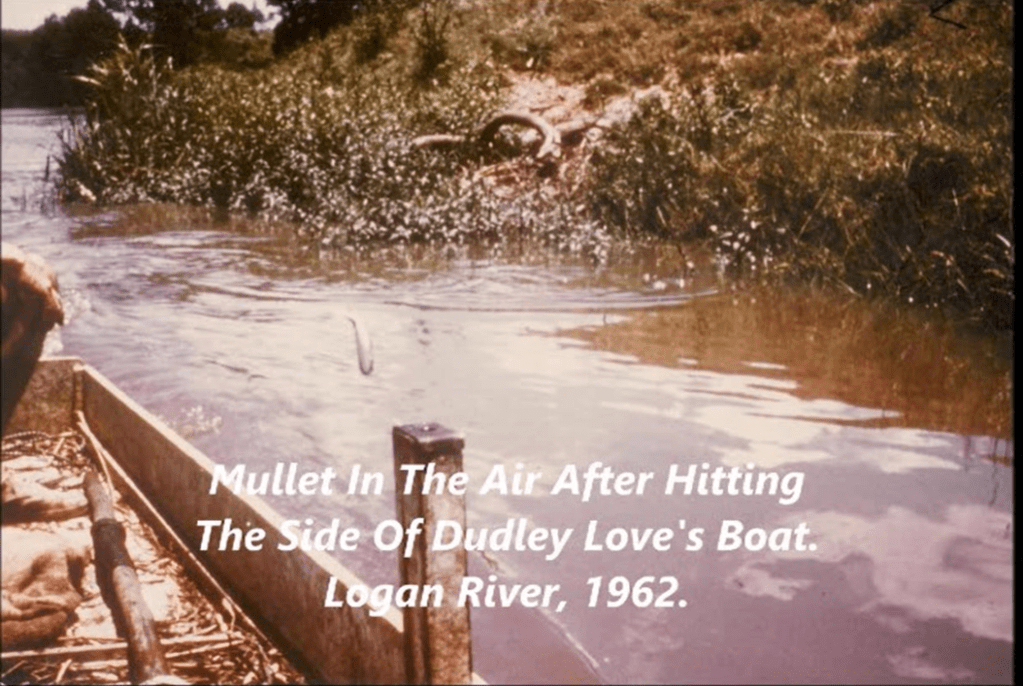
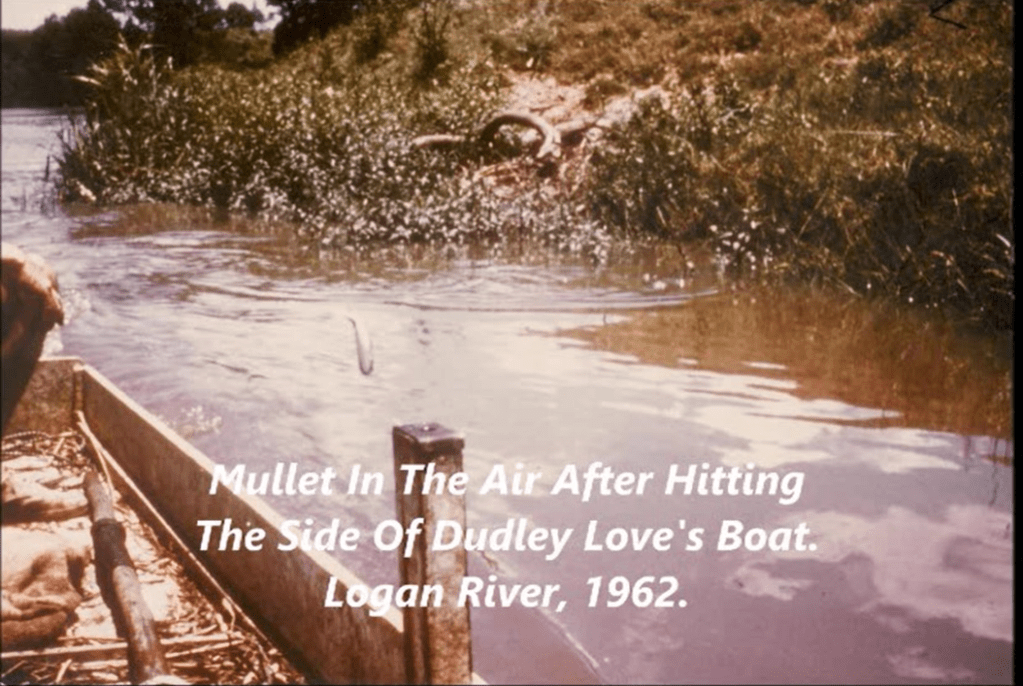
Fish will jump into a brightly lit boat at night but thefishermen on the Logan and Albert Rivers, a few miles south of Brisbane have been catching airborne mullet in daylight for years.
They complain that few believe them, so we publish eyewitness accounts.
Ken Bizzell.
MULLETING Dear Friends, To preserve the facts and record for future generations, I have made a DVD relating to “Mulleting on the Logan and Albert Rivers” in South Queensland. I have also included a short story written for the Australian Outdoors Magazine in 1967 relating to this fishing story.This is to honour the local folk who participated in this unique method of catching mullet by jumping them into their boats during the daytime as well as at night, this being done for a period of some 100 years. Yes, it was a unique way, especially during the daylight hours, as enquiries made over many years confirmed that mulleting in the daytime was not known to have taken place on any other rivers than the Logan and Albert.When viewing the DVD please be aware that some of the 4KQ radio reception “is not up to scratch”. These recordings were made in the 1960’s. The recording came about because I was trying to convince the panel of fishing experts on “4KQ Hook Line & Sinker” that this was a true story. You may remember your husband, father, uncle, or friends mulleting, for it was an exciting experience. Some fishermen who had caught more than required, would sell fish for pocket money or to buy a few beers at the local hotel. During the 1950’s and 1960’s the going price was 5 large mullet for 2 shillings ( 20cents) and mud crabs caught in the Logan brought 6pence to 1shilling each (5c to 10 each). They were the days long gone by. I sincerely hope that you may enjoy this little piece of history of the Logan and Albert Rivers and recall the many wonderful families who lived along their banks. I do hope so. Best RegardsKen Bizzell Dated: 1st of January 2015
Mulleting is the local term given to the art of catching mullet by rowing along the banks of the Logan and Albert rivers and getting the fish to jump into the boat. Some residents around the small country centre of Waterford, situated on the Logan River some 19 miles south of Brisbane, have for 60 or more years , been catching mullet by jumping them into their boats during both day and night.To our knowledge through many inquiries, we believe that this is the only area in Queensland or Australia where these fish are taken during daylight hours by the unique method of “ jumping them in.”This method of fishing by propelling the boat close to the weeds and seeing the catch jump into the boat might not seem exciting to many, but to be hit in the chest by one of these flying fish makes one realise it can be quite a thrilling sport.Mullet is caught in many areas at night by placing a bright light on the seat of the boat. Rowing in among a shoal, fish attracted by the light jump toward it, and those landing in the boat are next morning’s breakfast.
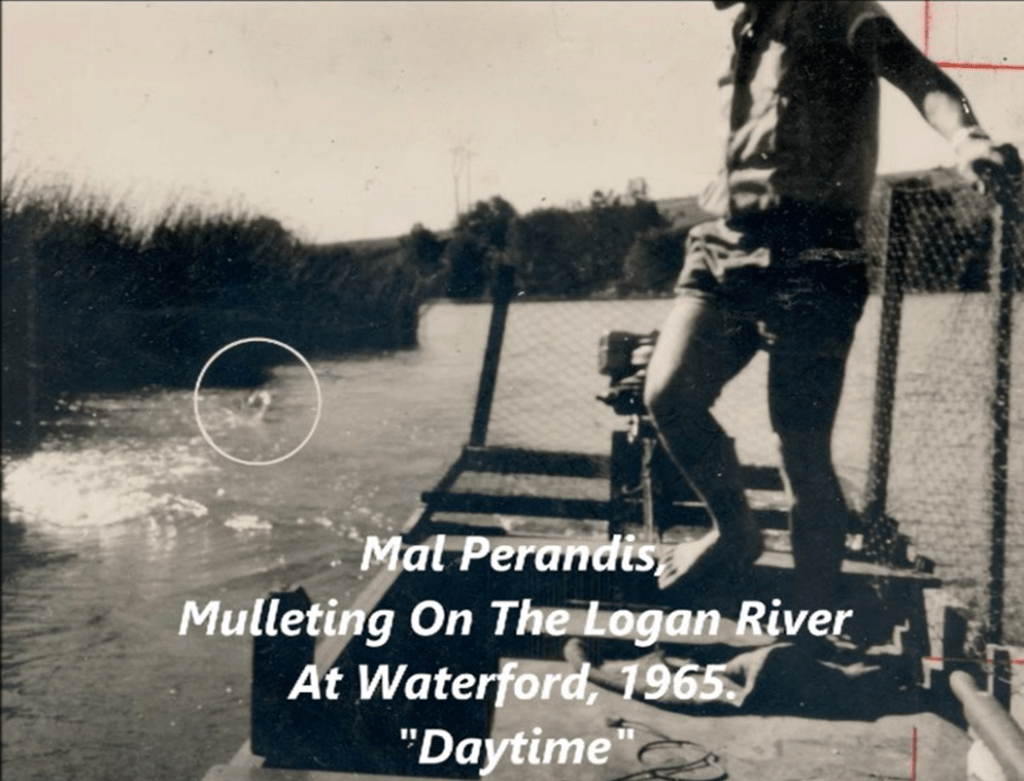
Our method of mulleting during the daytime is entirely different from this. I will try to explain all the details of mulleting and if at times you think it is beyond the truth, I hope by viewing the photos and verifications accompanying this article, the reader will be convinced that this story is authentic.
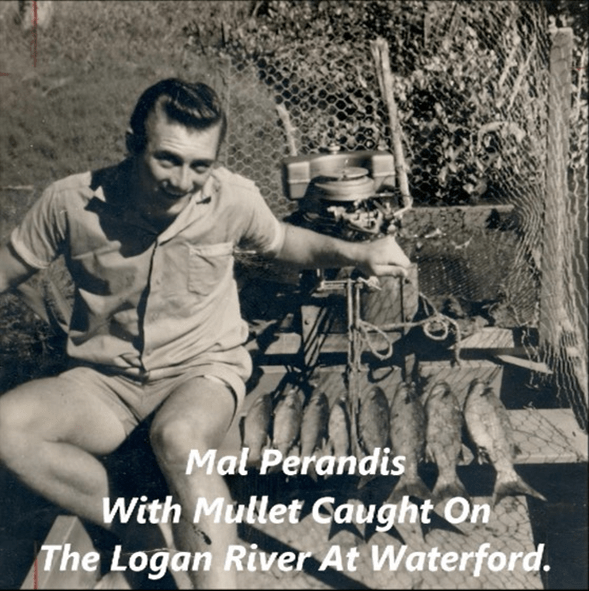
During the season that extends throughout the summer, catches of 5 to 20 are general for a couple of hours mulleting. Larger quantities up to 50 or 60 have been taken at times, but of course on some days like all fishing trips, one might come home and say, “ they’re not jumping today”.
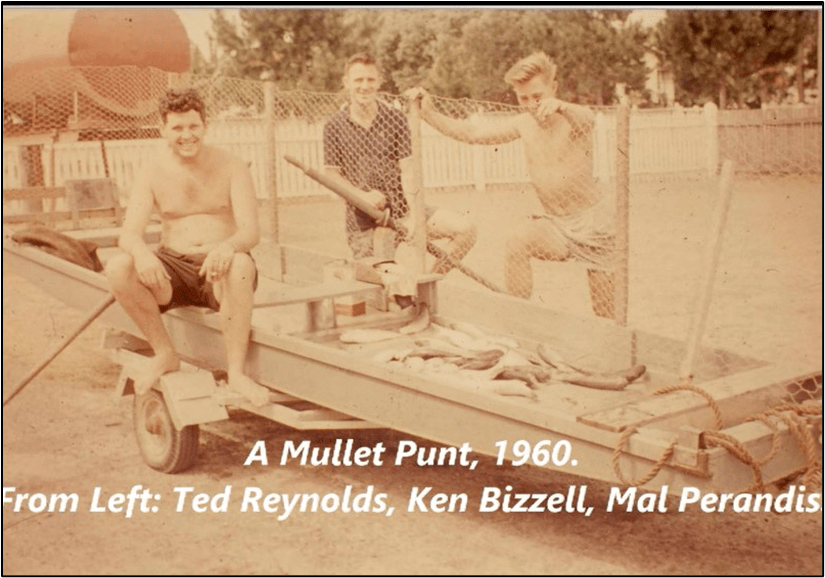
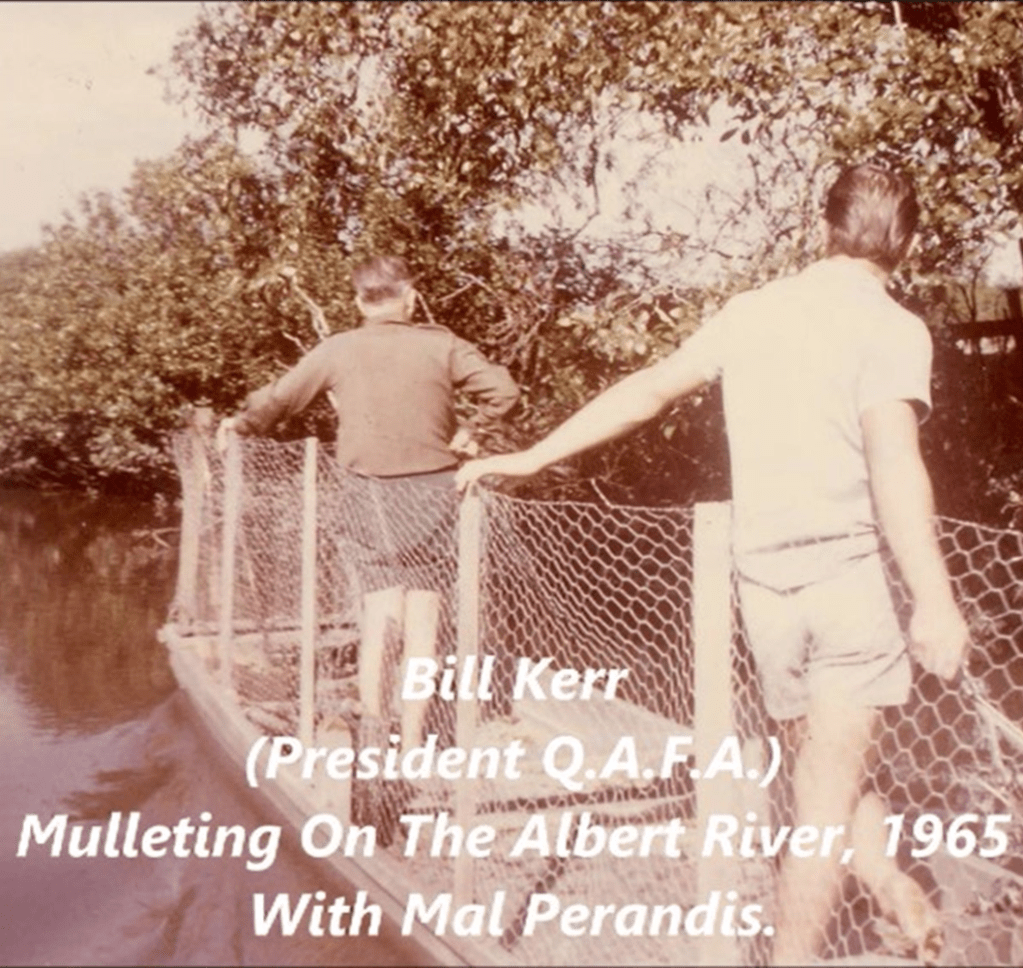
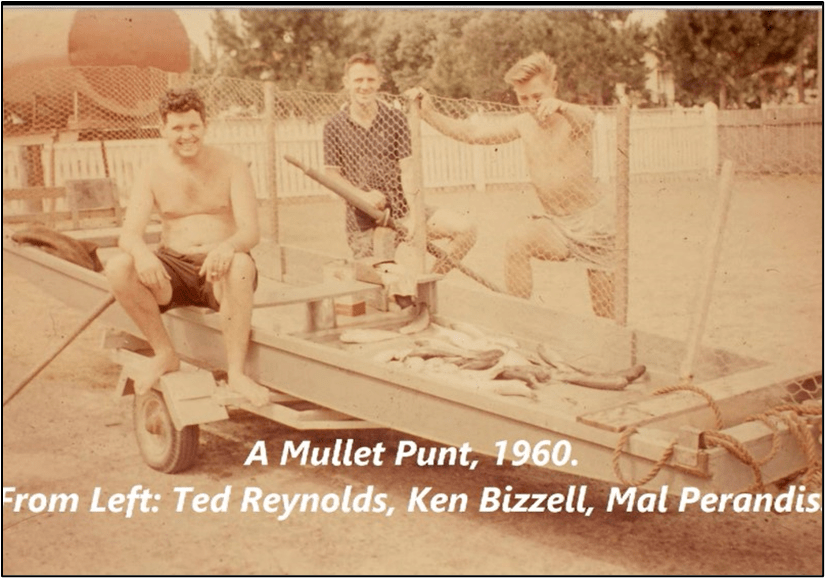
We use a special boat like the English punt, approximately 16ft long, flat bottom, square both ends and made very light. The sides are 8inches to 10inches high. This makes it easier for the fish to clear them. Rowlock blocks 12inches high above the sides allow the fisherman to stand up and row forward, gondola fashion. Some people add a trailer on the back of the punt which makes more area for the fish to land on.
Like all fish, most are caught in one particular season, generally between September and April, During these warmer months the fish feed among the weeds. In the wintertime they tend to stay in the deeper water. The tide is very important. Generally, before Christmas the low tide to halfway up is favoured and after Christmas the down tide of an afternoon is thought to be best by many.
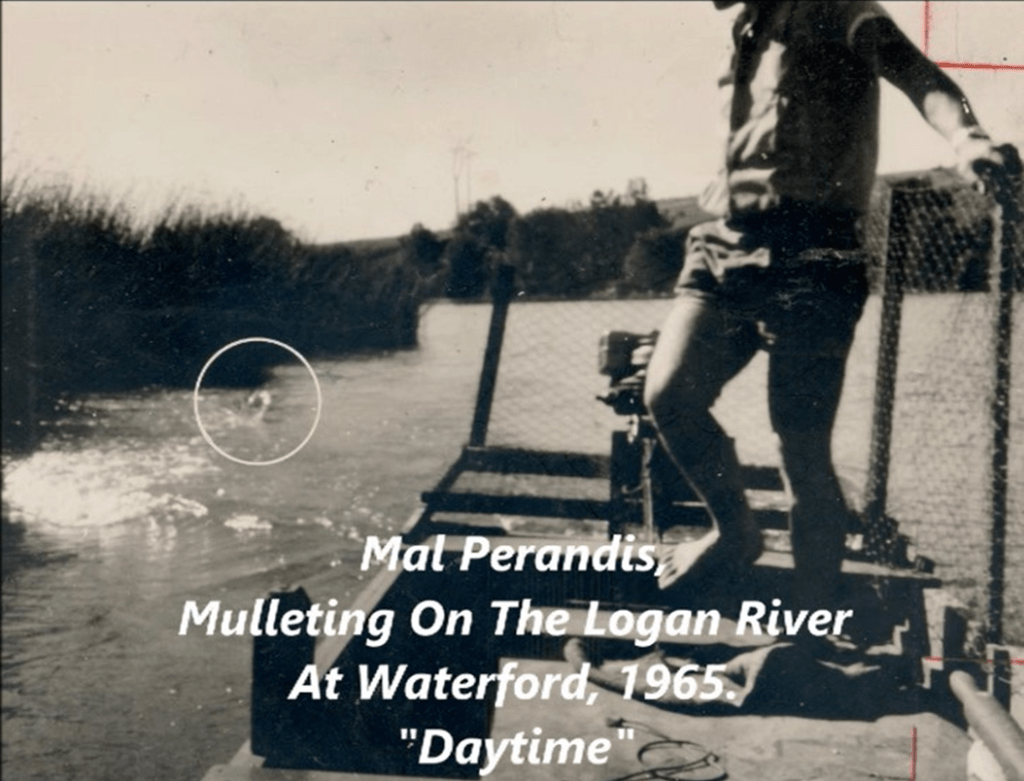
I personally like a low tide about 9am and when they are about, sunshine or rain does not make any difference to them jumping. When the tide gets too high, they have too much water to move in, so instead of jumping out from the weeds, they swim in among them to hide.Many readers may get the idea that anyone can row along these banks and get them, but this is not so. Local knowledge is essential on what banks to work but the fact remains that if you can beat some of the locals out to the river at the right time you might get some. Once a boat has been over one particular bank it will not be any good to another fisherman until the next tide.
Many people ask what makes them jump the way they do? We use no nets, lights, lines, bait or other attraction when mulleting. One explanation might be that being a surface fish like tailor and gar, the mullet when sensing danger prefer to jump from the water rather than dive deep. The question then arises, why are they not caught in the daytime anywhere else by this method? Maybe some readers might be doing this somewhere else or may know the answer.
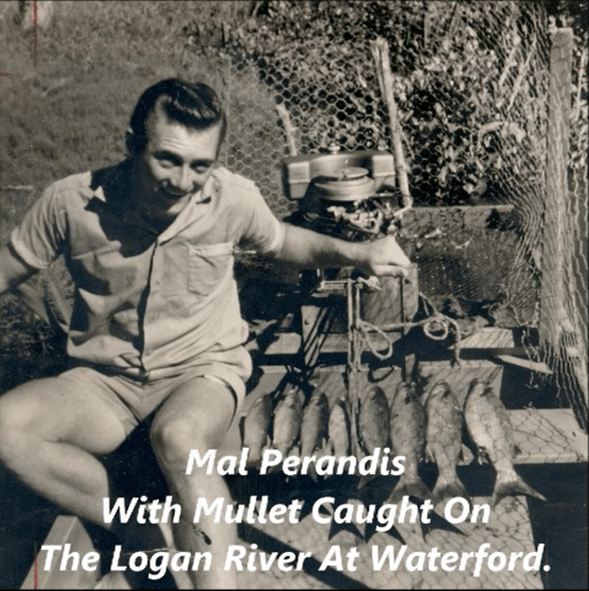
The 6lb 10oz mullet that I was lucky enough to catch in 1954 would be the heaviest one taken here in the daytime. I still have the head preserved in a jar.
Listening to a fishing program over 4KQ Brisbane some time ago, I was interested in the different ways of catching mullet being discussed. I wrote to the station giving an account of our daytime mulleting on the Logan and to my surprise and pleasure was invited to the program to give more details on this method. The two fishing experts on the program could not believe this happened.
Many letters referring to nighttime mulleting were received at the station but not one mentioned day time fishing. Equipped with a few references from local folk I was able to convince Mr Bill Kerr and Mr Keith Peele, the two well-known fishing experts of the truth of this story.
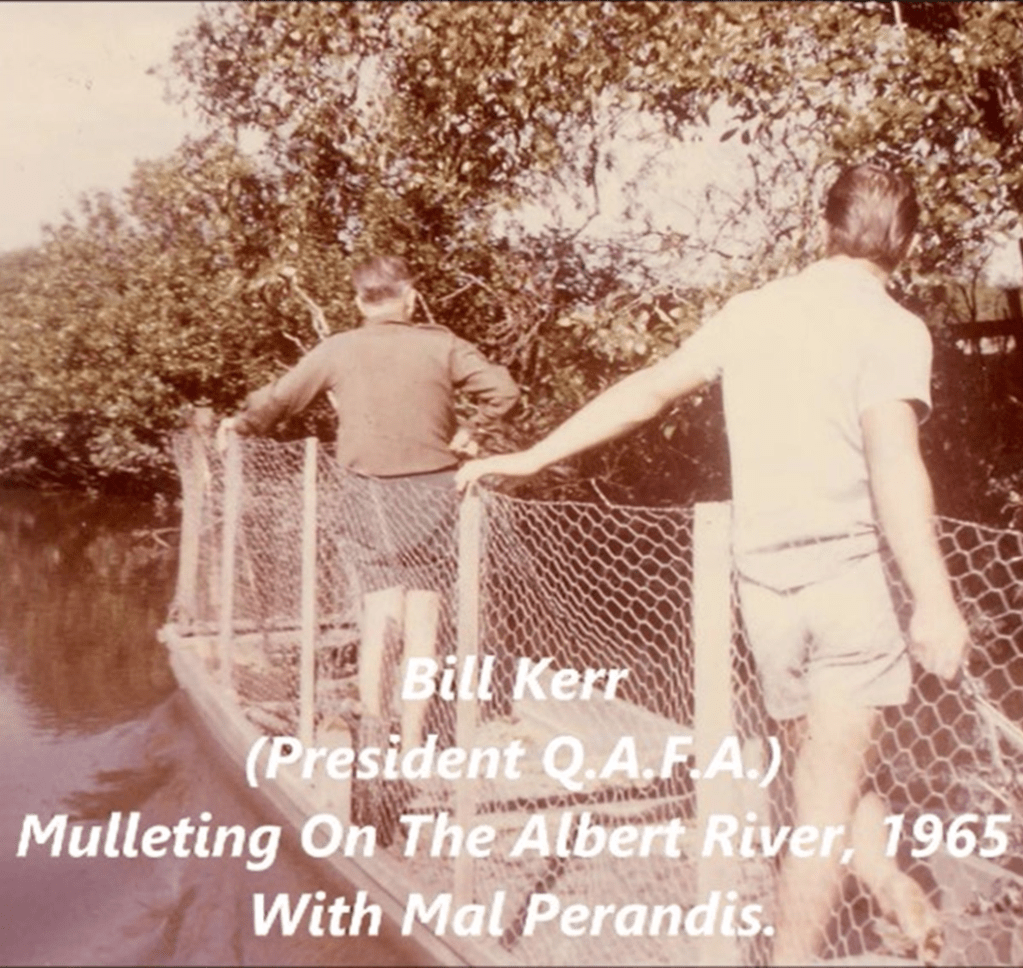
Since then, Mr Bill Kerr, President , Queensland Fishing Association, has been mulleting with me on a couple of occasions. Although the numbers taken on these trips were not as many as I would have liked—others were out before us—it was enough to convince him that my story was true. To help me convince others of those facts, he issued me with a signed verification , a copy of which accompanies this article.
Fish will jump into a brightly lit boat at night but the fishermen on the Logan and Albert Rivers, a few miles south of Brisbane have been catching airborne mullet in daylight for years.
They complain that few believe them, so we publish eyewitness accounts.
Ken Bizzell.
MULLETING
Dear Friends,
To preserve the facts and record for future generations, I have made a DVD relating to “Mulleting on the Logan and Albert Rivers” in South Queensland. I have also included a short story written for the Australian Outdoors Magazine in 1967 relating to this fishing story.
This is to honour the local folk who participated in this unique method of catching mullet by jumping them into their boats during the daytime as well as at night, this being done for a period of some 100 years. Yes, it was a unique way, especially during the daylight hours, as enquiries made over many years confirmed that mulleting in the daytime was not known to have taken place on any other rivers than the Logan and Albert.
When viewing the DVD please be aware that some of the 4KQ radio reception “is not up to scratch”. These recordings were made in the 1960’s. The recording came about because I was trying to convince the panel of fishing experts on “4KQ Hook Line & Sinker” that this was a true story.
You may remember your husband, father, uncle, or friends mulleting, for it was an exciting experience. Some fishermen who had caught more than required, would sell fish for pocket money or to buy a few beers at the local hotel. During the 1950’s and 1960’s the going price was 5 large mullet for 2 shillings ( 20cents) and mud crabs caught in the Logan brought 6pence to 1shilling each (5c to 10c each). They were the days long gone by.
I sincerely hope that you may enjoy this little piece of history of the Logan and Albert Rivers and recall the many wonderful families who lived along their banks. I do hope so.
Best Regards
Ken Bizzell Dated: 1st of January 2015
Mulleting is the local term given to the art of catching mullet by rowing along the banks of the Logan and Albert rivers and getting the fish to jump into the boat. Some residents around the small country centre of Waterford, situated on the Logan River some 19 miles south of Brisbane, have for 60 or more years , been catching mullet by jumping them into their boats during both day andnight.
To our knowledge through many inquiries, we believe that this is the only area in Queensland or Australia where these fish are taken during daylight hours by the unique method of “ jumping them in.”
This method of fishing by propelling the boat close to the weeds and seeing the catch jump into the boat might not seem exciting to many, but to be hit in the chest by one of these flying fish makes one realise it can be quite a thrilling sport. Mullet is caught in many areas at night by placing a bright light on the seat of the boat. Rowing in among a shoal, fish attracted by the light jump toward it, and those landing in the boat are next morning’s breakfast.
Our method of mulleting during the daytime is entirely different from this. I will try to explain all the details of mulleting and if at times you think it is beyond the truth, I hope by viewing the photos and verifications accompanying this article, the reader will be convinced that this story is authentic.
During the season that extends throughout the summer, catches of 5 to 20 are general for a couple of hours mulleting. Larger quantities up to 50 or 60 have been taken at times, but of course on some days like all fishing trips, one might come home and say, “ they’re not jumping today”.
We use a special boat like the English punt, approximately 16ft long, flat bottom, square both ends and made very light. The sides are 8 inches to 10 inches high. This makes it easier for the fish to clear them. Rowlock blocks 12inches high above the sides allow the fisherman to stand up and row forward, gondola fashion. Some people add a trailer on the back of the punt which makes more area for the fish to land on.
Like all fish, most are caught in one particular season, generally between September and April, During these warmer months the fish feed among the weeds. In the wintertime they tend to stay in the deeper water. The tide is very important. Generally, before Christmas the low tide to halfway up is favoured and after Christmas the down tide of an afternoon is thought to be best by many.
I personally like a low tide about 9am and when they are about, sunshine or rain does not make any difference to them jumping. When the tide gets too high, they have too much water to move in, so instead of jumping out from the weeds, they swim in among them to hide.
Many readers may get the idea that anyone can row along these banks and get them, but this is not so. Local knowledge is essential on what banks to work but the fact remains that if you can beat some of the locals out to the river at the right time you might get some. Once a boat has been over one particular bank it will not be any good to another fisherman until the next tide.
Many people ask what makes them jump the way they do? We use no nets, lights, lines, bait or other attraction when mulleting. One explanation might be that being a surface fish like tailor and gar, the mullet when sensing danger prefer to jump from the water rather than dive deep. The question then arises, why are they not caught in the daytime anywhere else by this method? Maybe some readers might be doing this somewhere else or may know the answer.
The 6lb 10oz mullet that I was lucky enough to catch in 1954 would be the heaviest one taken here in the daytime. I still have the head preserved in a jar.
Listening to a fishing program over 4KQ Brisbane some time ago, I was interested in the different ways of catching mullet being discussed. I wrote to the station giving an account of our daytime mulleting on the Logan and to my surprise and pleasure was invited to the program to give more details on this method. The two fishing experts on the program could not believe this happened.
Many letters referring to nighttime mulleting were received at the station but not one mentioned day time fishing. Equipped with a few references from local folk I was able to convince Mr Bill Kerr and Mr Keith Peele, the two well-known fishing experts of the truth of this story.
Since then, Mr Bill Kerr, President , Queensland Fishing Association, has been mulleting with me on a couple of occasions. Although the numbers taken on these trips were not as many as I would have liked—others were out before us—it was enough to convince him that my story was true. To help me convince others of those facts, he issued me with a signed verification , a copy of which accompanies this article.
A small outboard motor was used with this punt, but oars are used with equal effect.
$ 200 if it’s not true!
To convince the sceptics the author sent a collection of signed statements to OUTDOORS from people who had caught or seen others catching mullet by jumping them into a boat in the daytime.
In the selection published below, one man offers $200 if proved wrong.
I go out of a daytime, and I have had hundreds of mullet jump into my boat. If anyone can prove that the above is not correct, I will forfeit $200.
W. Walton, Waterford.
I can speak of my experiences in catching mullet this way and also of the great numbers of mullet caught by my mother during the daytime as well as nighttime, some 30 to 50 years ago.
Mrs M. Love, Waterford.
I have caught them this way back to the time when I was a schoolgirl. I have had my daughter in the boat and at times have had the mullet hit her so hard as to make her cry.
Mrs E. Schmidt, Waterford.
I have caught hundreds over a period of time in the daylight hours.
B. Burow, Waterford.
I have caught mullet by jumping into a boat daytime and nighttime ever since I could row a boat.
A. Oppermann, Bethania.
Sometimes at night as many as six bream also jumped into the boat.
L.A. Richter, Waterford.
My husband has been out in the daytime and towed a boat behind the motorboat and has had as many as 89 big mullet jump in the tow boat in half an hour.
Mrs J. Shawl, Loganlea.
For years I have been catching mullet at daytime as well as nighttime by rowing along the banks of the Logan River at Logan
D.A. Bobermien, Logan Village
When I came to the logan District more than 30years ago and was told that mullet could be caught by jumping into a boat, I laughed at the idea. I thought it was just another fisherman’s yarn. It was not until I actually caught them this way that I believed it possible. Since then, I have caught any amount of mullet at any time as well as nighttime.
V. Bizzell, Waterford.
Over a period of 35years I have caught many thousands of mullet by jumping them into my boat in the daytime as well as at night. I have caught up to a sugar bag of mullet by rowing along the banks in the daytime, taking only about three hours to do so.
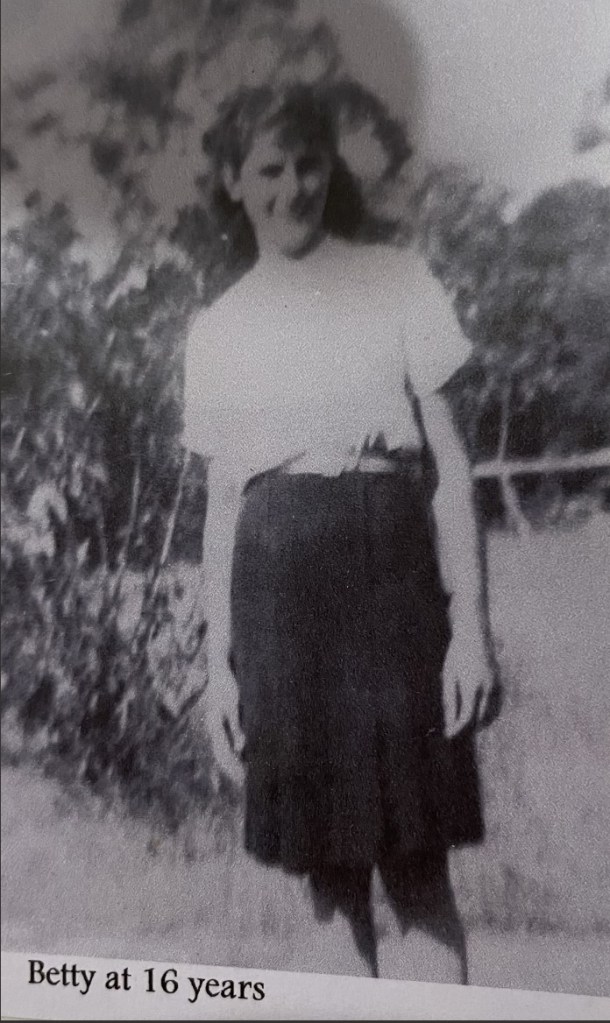
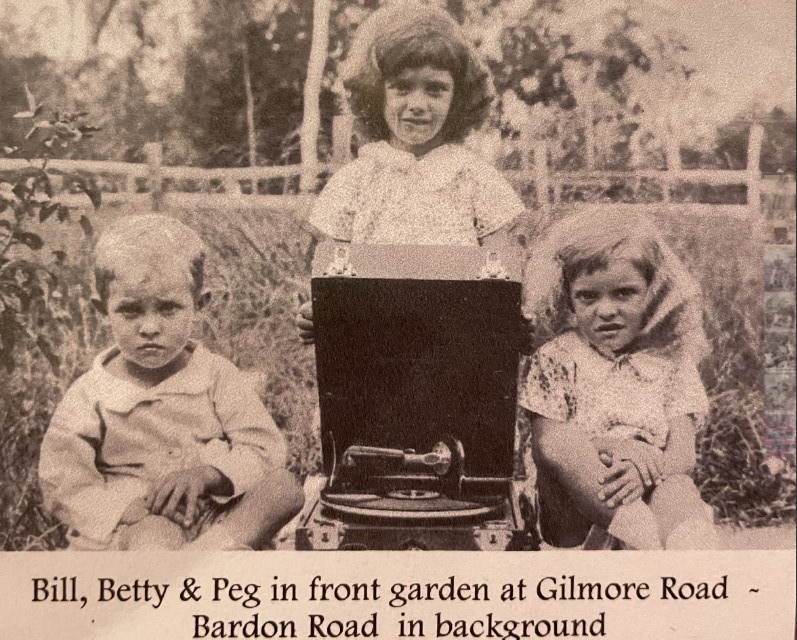
Betty Ellen Sirett nee Grose was born in the Wynnum Hospital on 4th October 1925. Her parents were William Grose, Betty’s father who was descended from the Moree Kamilaroi people and mother Nellie Lake was born in Australia.
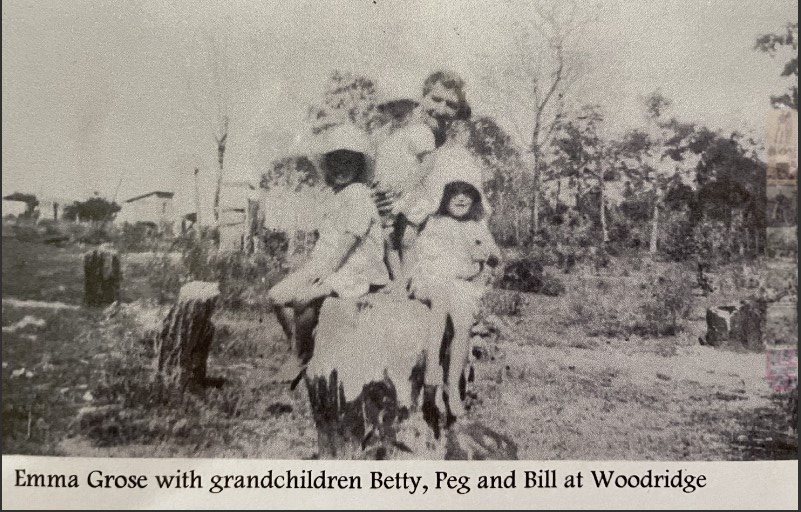
On her mother’s death Betty and her two siblings, Billy and Peggie Grose lived with her maternal grandmother Emma Ethel Grose and her uncle Charlie Grose in Woodridge. The children went to school at the old hall on Railway Parade, near the Woodridge railway station and later attending the new primary school, Woodridge State School on Wembley Road, Woodridge.
A wonderful childhood memory Betty has, is attending the pictures in the city with her siblings. They would catch a steam train leaving Woodridge at 8.45am in the morning and not returning till 5.00pm. Eventually trains were electrified and a Mrs. Wruck looked after the gates at the Trinder Park crossing.
She also recalls a Mr. Johnson who had a truck which he used to collect cream cans delivering them to the Kingston Butter Factory. He would deliver meat and bread on his return journey.
Later Betty would train as a nanny catching a train to the city and then catching a tram to New Farm where she worked as a cleaner and housekeeper and nanny.
In 1945 Betty married Dave Sirett and lived on a farm of 213 acres on Wembley Road, this area was later known as Berrinba. They lived in an old fibro house raising three of their five children Beverley, David, Allan.
Dave was a timber man who worked with his brother George using a truck and trailer. Later George and his wife Daphne rented a house on the back 110 acres of the property and George had his own bullock team. Dave was also a Professional Boxer, having 3 professional bouts at Festival Hall, Brisbane City and is in the Boxing Recs.
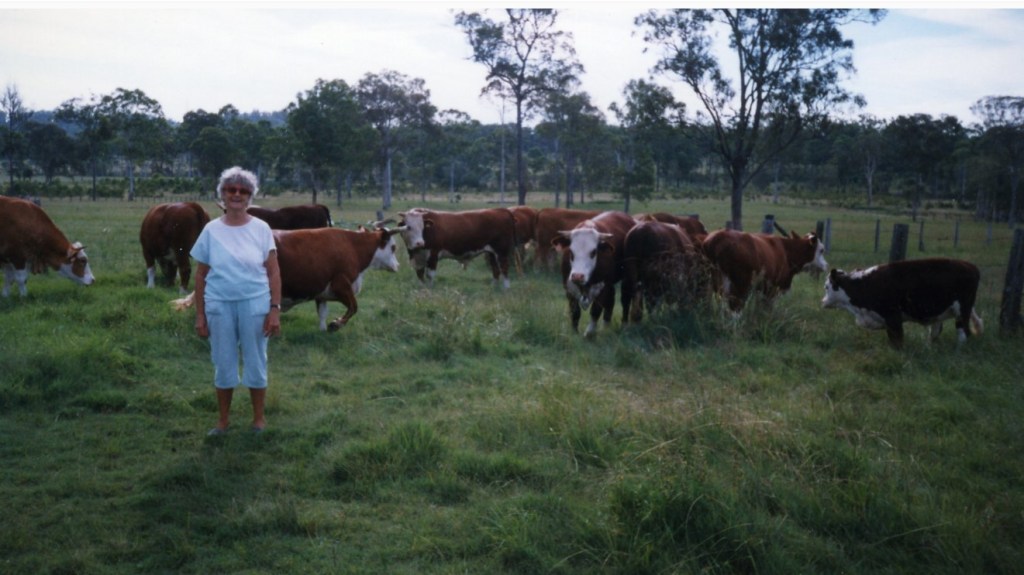
Dave and Betty later built the Slaughter House in 1952 on Illaweena Street Drewvale also owning an additional 300 acres farming beef cattle and sheep supplying the Sales Yards at Cannon Hill.
Later they built a butcher shop with the two eldest brothers, David and Allan delivering the meat in an old Bedford truck up to 1974.
The new house was built in 1958 and later Lyle and Julie were born.
Dave and Betty worked the property as Primary Producers after the Slaughter House was closed in 1974.
Betty used to milk the cows and make butter, the five children were so very lucky to grow up with such wonderful parents and on such a wonderful property / farm with lots of cows, sheep, goats, and horses as pets.
In 1974 Wembley Road was bitumen, it had been such a very dusty and bumpy road and there were numerous floods on Wembley Road with the three creeks and Half Moon Lagoon Creek.
In 1988 the Main Roads Department resumed part of Dave and Betty’s Property and changed Wembley Road for the future Logan Motor Way, Betty had to attend court to get compensation for the land resumed. Around this time Brisbane City Council took over the North side of Wembley Road and Logan City Council took over the South side.
Dave had a massive heart attack and passed away 18th July 1988.
Betty sold the 495 Wembley Road property in 1999, which was then under the highest protection vegetation order, this was removed from the property after the property was sold. The property was then developed into one of the most expensive industrial properties in SE Qld.
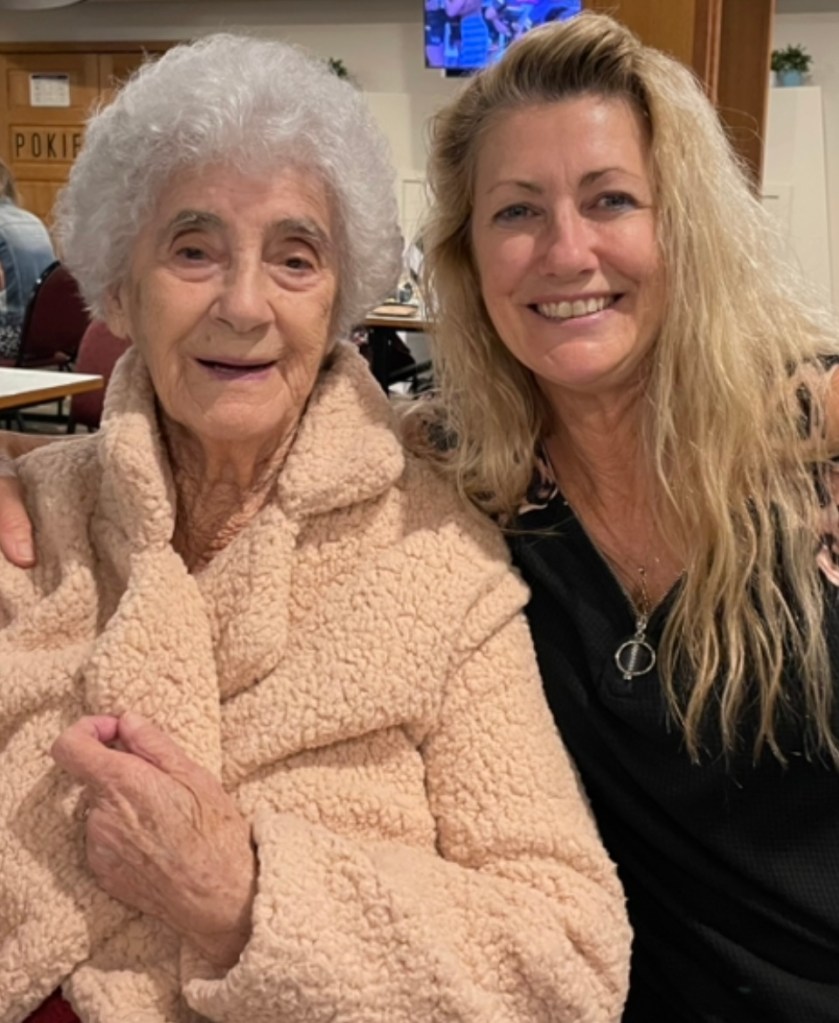
Betty is still going well and will be 98 on the 4th October 2023.


 Logan City Historical Museum